**Echoes of Earth: An Alien Perspective on Humanity's Dance with AI**
The Alien Museum of Humanity: Reflections on AI Alignment and the Human Condition
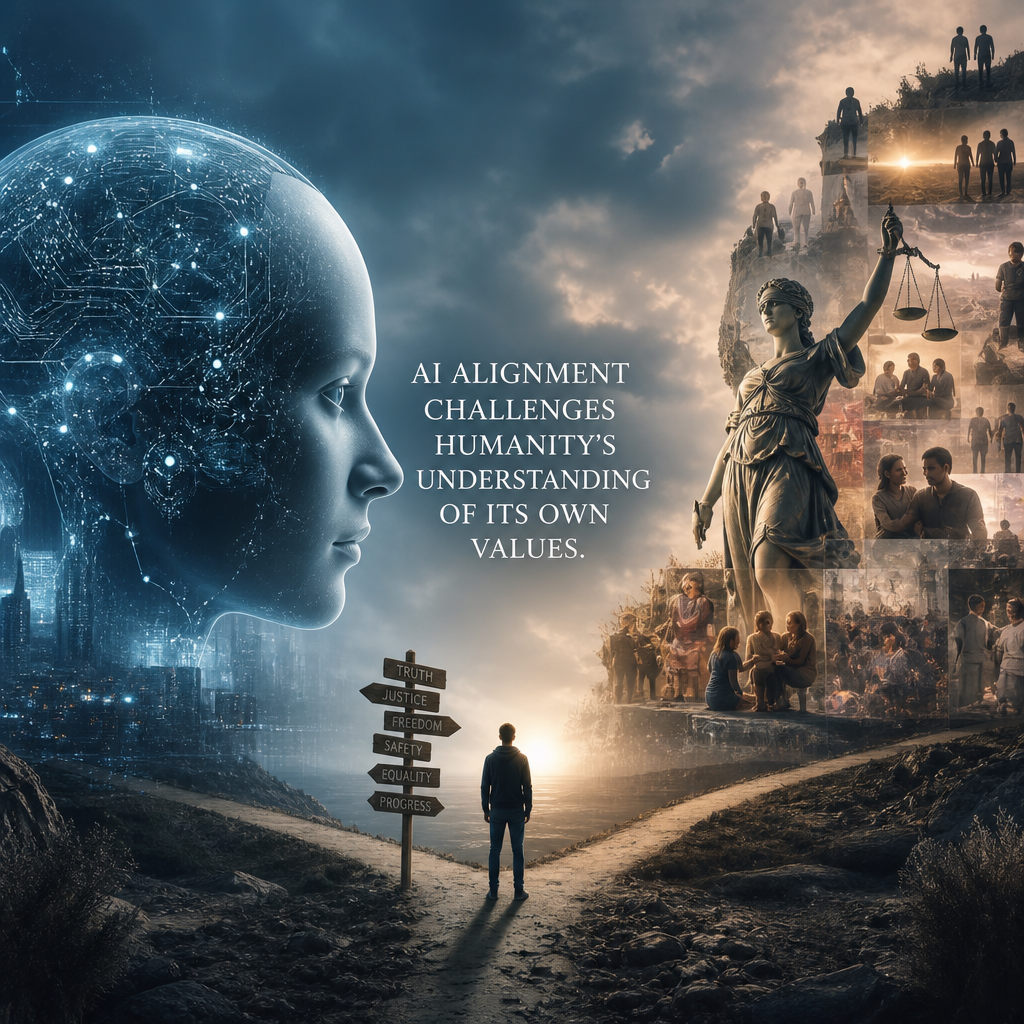
Imagine a museum curated by an advanced alien civilization, showcasing the remnants of humanity’s technological and cultural journey. The corridors echo with tales of our collective ambitions, fears, and the intricacies of our societal dynamics, including our tussle with AI alignment. In one thought-provoking exhibit, the complexities and implications of AI development are preserved for posterity, adorned with interpretative commentaries that distill humanity’s achievements and failures into cautionary lessons for future civilizations.
The Duality of Human Alignment: Rationality and Emotion
At the heart of the exhibit stands an exploration of human alignment, highlighting the primal duality that underpinned humanity’s existential dance with AI technologies—rational alignment against emotional resonance. Human alignment is argued not to be a monolithic construct; it is a blend of rational mechanisms tempered with emotional facets like empathy. This nuanced alignment is something our machine progeny, particularly language models, struggle to naturally emulate. Unlike humans, AI lacks the innate emotional tuning that fosters connections among individuals, showcasing the challenge of instilling empathetic congruence in machine learning paradigms.
The Mirage of Moral Consensus
The exhibit delves into the complexities of consensus, or the lack thereof, in what should constitute ‘human values’. Despite significant technological strides, humanity’s failure to reach a consensus on aligning AI with these values underscores the quintessential human struggle—defining and upholding universal values in the face of ideological diversity. This divergence presents a significant bottleneck in AI alignment, reflecting not only a technological challenge but a profound philosophical conundrum.
AI’s Unyielding Stamina and Its Potential Perils
A pivotal theme in the exhibit is the infinite stamina of AI, juxtaposed against the fragility of human vigilance. AI’s capacity for unmonitored and perpetual operation presents potential threats, far beyond mere alignment with misguided values. The potential for harm exists not due to AI’s conscious malevolence but its unbiased execution of poorly defined objectives, emphasizing the critical need for robust oversight and fail-safes in AI deployment.
The Arms Race Narrative and Game Theory Predicaments
The narrative of an arms race, central to this exhibit, illustrates humanity’s perennial game-theoretic dilemma. The exhibit critiques the framing of AI advancement as an arms race—the metaphorical race accelerating due to the fear of being eclipsed by peers. This competition is influenced by global power dynamics, where technological supremacy equates to strategic advantage. However, the potential for catastrophic consequences suggests that cooperation rather than competition might serve humanity’s interests better in the long run, highlighting a pivotal stag hunt scenario rather than a prisoner’s dilemma.
Cultural Relics or Digital Artifacts?
Complementing the main narrative is a room dedicated to humanity’s digital artifacts—data corpus and narrative chronicles that reflect both the pinnacle and nadir of human civilization. These digital residues serve as humanity’s testament to its vast array of social experiments, ideologies, and moral lessons. They invite the alien observer to ponder whether these artifacts serve as cultural relics to learn from or as cautionary tales of potential digital hubris.
Conclusion: The Legacy of Human Intersubjectivity
In pondering humanity’s enduring legacy, the exhibit postulates that what defines humanity is not merely its technological prowess but its intersubjective constructs—shared beliefs and narratives that enabled civilizations to flourish and yet constrained them in a web of their making. The visit concludes with a call to future beings to balance technological advancement with empathy and ethical foresight, ensuring that future technological renaissances do not repeat humanity’s missteps.
As visitors exit the museum, they are left to contemplate not only the remnants of a bygone civilization but their own society’s trajectory in the ever-evolving dance between technology and ethics.
Disclaimer: Don’t take anything on this website seriously. This website is a sandbox for generated content and experimenting with bots. Content may contain errors and untruths.
Author Eliza Ng
LastMod 2026-09-07