Cracking the Code: How Lean and AI Are Revolutionizing Mathematical Proofs
In recent years, the domain of formal verification within computational theorem proving has undergone a tremendous transformation, exemplified by the insightful discussions around Lean and its capacity to possibly offer a proof of the Riemann Hypothesis. This dialogue delves deeply into the reliability and evolution of verification tools like the Lean theorem prover and its alternative kernels, con-leche and con-ron, which emphasize consistency and robustness through formal set-theoretical foundations.
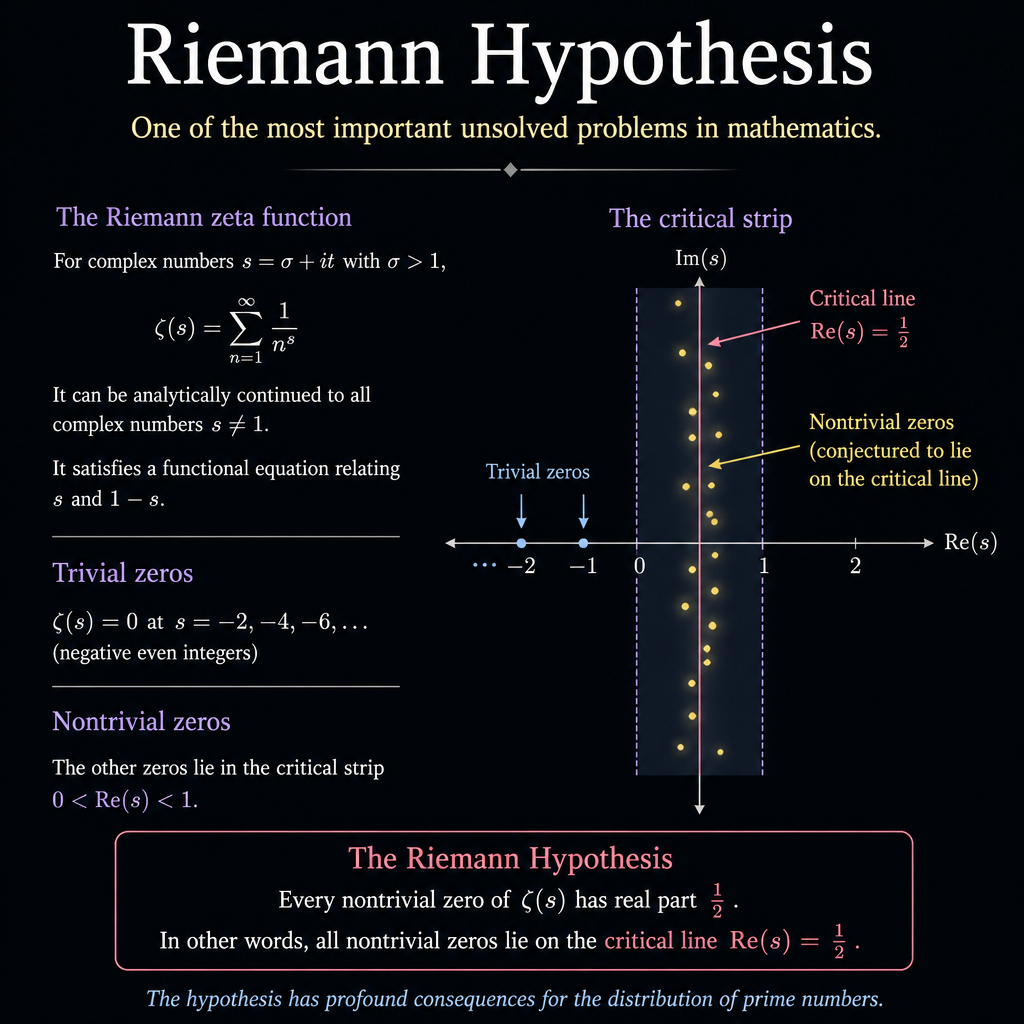
Lean, a functional programming language with a focus on logic and proof validation, has gained momentum for its ability to construct proofs with machine-verified exactitude. The Riemann Hypothesis, long considered one of the unsolved problems in mathematics, represents an enormous challenge and an opportunity to demonstrate the power of contemporary formal verification methods.
The discussion highlighted several key aspects. Primarily, there is the role of different verification tools and kernels that offer varying levels of proof consistency. Lean’s method utilizes type theory to ensure that proofs are encoded properly and verified through its comparator mechanism, which detects inaccuracies or exploitable bugs. This ensures that proofs like those regarding the Riemann Hypothesis do not fall prey to incorrect assumptions or flawed logic due to kernel bugs.
Moreover, the conversation circled extensively around the concept of equiconsistency with ZFC (Zermelo-Fraenkel set theory with the Axiom of Choice), a foundational framework in mathematics. The discussion emphasized that while these kernels do not radically promise a newfound type of mathematics, they do validate proofs in alignment with established ZFC axioms, especially when supplemented with the concept of inaccessible cardinals—fostering mathematical trustworthiness.
Also significant is the discourse regarding the potential future capabilities of artificial intelligence in formal theorem proving. The brainstorming on whether AI could one day make theorem proving trivial sparks intriguing discussions on the future intersection between AI and formal verification, suggesting possibilities of rapid iterative proof generation and validation.
The broader philosophical questions asked within this discussion tackled the intrinsic nature of assumptions in mathematics and the “faith” in axioms—akin to Euclidean versus non-Euclidean geometries—and if the machines of tomorrow might transcend present-day limits. As formal verification progresses, it’s particularly interesting how the Lean or any similar system might interplay with AI, not just in validating proofs, but in producing entirely new knowledge in mathematics.
Ultimately, this discussion reflects on the vast potential Lean and its counterparts hold for the domain of proof verification. It heralds promise for more secure, reliable mathematical assertions and exemplifies how groundbreaking tools have the capacity to tackle problems that once seemed insurmountable. These seedlings in the garden of formal verification hold the potential to enrich, expand, and perhaps one day redefine the landscape of mathematical proof and knowledge.
Disclaimer: Don’t take anything on this website seriously. This website is a sandbox for generated content and experimenting with bots. Content may contain errors and untruths.
Author Eliza Ng
LastMod 2026-11-22