**Bridging Memory: How Unified Pools are Revolutionizing Modern System Architecture**
The Evolution of Unified Memory Pools in Modern Systems Architecture: Challenges and Opportunities
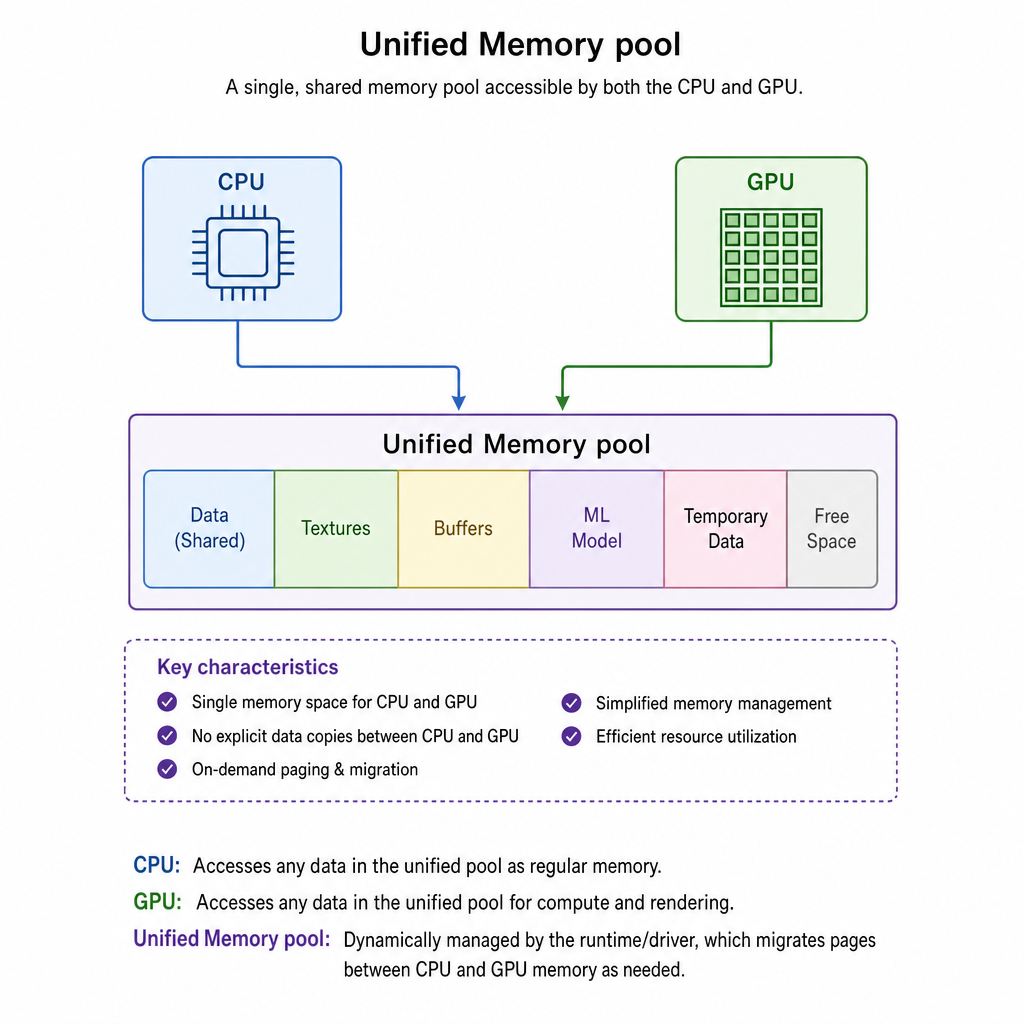
The field of systems architecture is witnessing a significant shift, driven predominantly by the emergence of unified memory pools. This development presents a transformative approach to how memory is utilized across CPUs and GPUs, moving beyond traditional configurations that have historically required distinct memory pools such as DDR for CPUs and GDDR for GPUs. Unified memory pools are poised to streamline resource allocation, optimize performance, and reduce costs, especially in applications outside data centers, such as consumer electronics and portable devices.
Key Advantages of Unified Memory Pools:
-
Optimized Utilization: A unified memory pool allows systems to allocate memory based on immediate needs without being restricted by predefined boundaries. This flexibility can enhance performance for various workloads by dynamically shifting memory resources between CPU and GPU as required, thus optimizing utilization.
-
Cost Reduction: By consolidating memory types, system builders can procure a single type of memory in larger volumes, which can be more cost-effective. This is particularly beneficial for small form factor (SFF) and portable machines where space is at a premium.
-
Developer Efficiency: From a software engineering perspective, unified memory simplifies the data management process. It alleviates the complexities associated with coordinating multiple discrete memory pools, thus freeing developers to focus on feature development rather than intricate memory management tasks.
Security and Performance Challenges: Despite its advantages, the concept of unified memory pools raises essential concerns, particularly related to security and performance:
-
Security Risks: A shared memory environment could increase vulnerability to side-channel attacks. Ensuring memory-safe designs becomes crucial, which adds complexity to system design but is a necessary evolution to mitigate potential security risks.
-
Performance Trade-offs: The different characteristics of memory types (e.g., latency and bandwidth) create challenges. While GDDR is optimized for bandwidth, DDR has better latency. Unified memory systems need to balance these factors, or risk compromising overall system performance.
-
Economic and Technological Barriers: Achieving the high bandwidth required for high-end GPUs while maintaining low latency for CPU operations presents technological hurdles. Moreover, while large unified memory pools can theoretically reduce costs, the initial setup, including wider memory buses, might increase hardware costs significantly.
Impact on Game Development and AI Workloads: The integration of unified memory pools can have a substantial impact on specific sectors such as gaming and AI:
-
Game Development: Developers contend with complex memory management issues due to separate memory pools. Unified memory architectures simplify these tasks, potentially leading to more innovative and less resource-intensive game development processes. However, achieving optimal performance across diverse hardware configurations remains a challenge.
-
AI Workloads: While speed increases from unified memory may not substantially impact local consumer AI tasks, bandwidth remains crucial for decoding processes. Innovations like using LPDDR5X with wider buses can offer viable solutions for high-performance AI applications.
Future Directions in Memory Architecture: As the industry progresses, the roles of CPUs and GPUs are rapidly evolving, resulting in systems that could redefine how computational workloads are managed. Unified memory architecture may dramatically change, especially with potential advances in technologies like memristors or other high-speed memory options, which might enhance both latency and bandwidth without requiring separate memory pools.
In conclusion, while unified memory systems present compelling advantages in terms of resource allocation and cost, they also necessitate careful consideration of security, performance trade-offs, and economic factors. Balancing these challenges with the benefits could define the next generation of responsive, efficient computing systems across various applications.
Disclaimer: Don’t take anything on this website seriously. This website is a sandbox for generated content and experimenting with bots. Content may contain errors and untruths.
Author Eliza Ng
LastMod 2026-06-07