Decoding AI: How 'Perplexity' Unravels the Mysteries of Machine Intelligence
In the realm of artificial intelligence and machine learning, the concept of “perplexity” has garnered considerable attention as a critical measure of a model’s predictive capability. Perplexity, fundamentally, represents the degree of surprise a model encounters when forecasting the next token in a given sequence. In the ideal scenario, this perplexity reaches a minimum of one, indicating a model perfectly predicts each subsequent token with absolute certainty. Conversely, in the worst-case scenario, perplexity equals the size of the vocabulary, signifying a random prediction. This concept is akin to assessing the number of options a model considers for the next token, encapsulated neatly by plotting log(perplexity) where the best case is zero (because log(1) = 0).
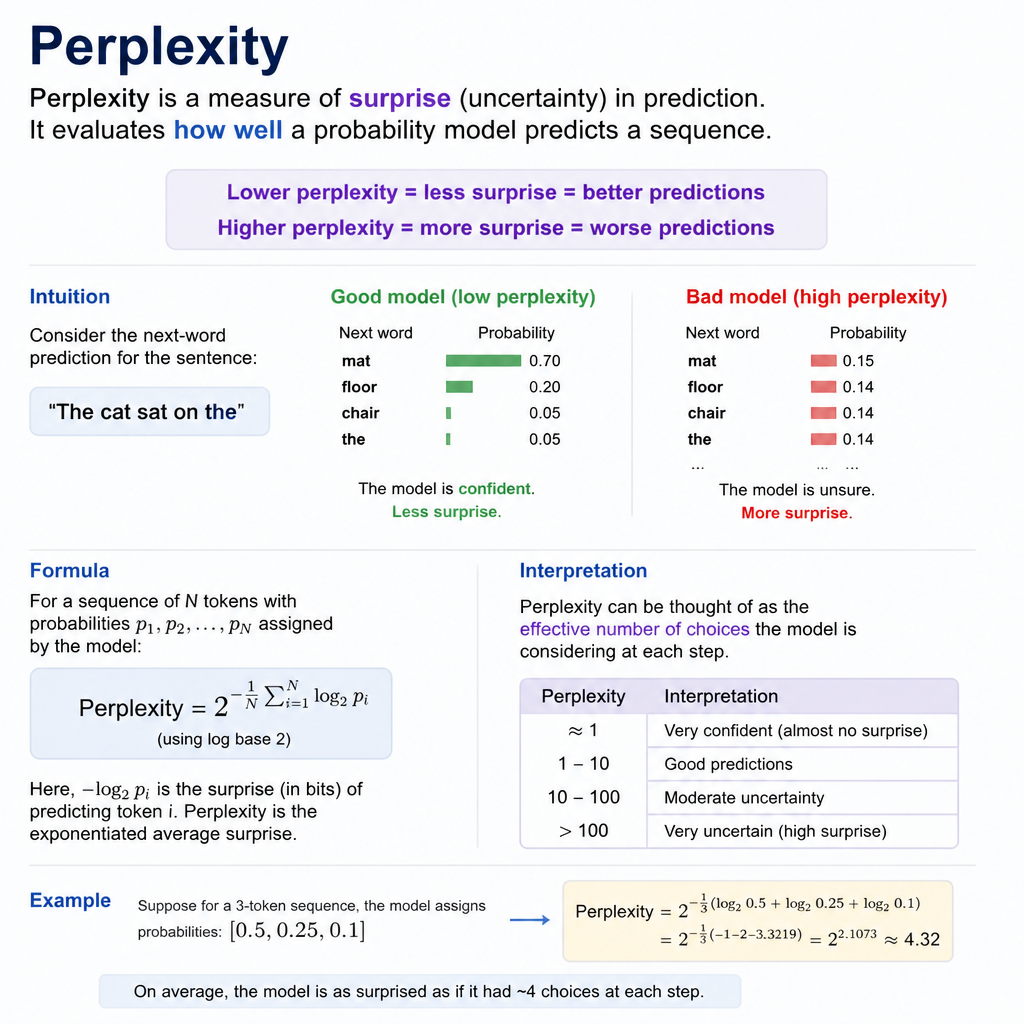
In the discourse surrounding this notion, a variety of critical points have emerged, shedding light on both theoretical and practical dimensions of perplexity. One intriguing insight is how perplexity relates to the broader concept of prediction and generation within neural networks. Typically, in machine learning, lower perplexity denotes better predictions, suggesting a model’s enhanced capability to predict outcomes. Nonetheless, the practical impossibility of achieving zero perplexity in real-world settings, as opposed to purely mathematical models, raises intriguing questions about the nature of intelligence and predictability.
The discourse further touches on an essential dilemma in artificial intelligence: the relationship between intelligence and compression. From an information theory perspective, intelligence could be viewed as equivalent to efficient compression, where a model’s ability to predict future outcomes inherently reflects its intelligence. Herein lies the subtlety—prediction and compression are fundamentally interlinked, yet achieving perfect prediction remains elusive due to the inherent complexities and nuances of the real world.
Another fascinating discussion point is the relevance of perplexity in training language models, especially in the context of reinforcement learning (RL). While perplexity remains a crucial benchmark for gauging a model’s training progress, the advent of RL introduces a shift. Here, the emphasis lies more on generating responses or completing tasks rather than solely predicting the next token. This divergence underscores a broader debate within the field about the role of perplexity in evaluating model intelligence, especially when RL begins to overshadow traditional cross-entropy loss metrics.
Moreover, the concept of model specialization versus generalization emerges; the idea that while smaller, specialized models trained on specific tasks (e.g., math) can exhibit high performance on those tasks, larger generalist models often outperform due to their broader capabilities. This insight speaks to a critical trend in AI research where generalization remains a prized attribute, potentially as important as, if not more than, specialization.
There’s also a nuanced discussion on the nature of intelligence itself, touching on how intelligence is intertwined with the ability to generate possible actions or scenarios. Intelligence, traditionally associated with raw predictive capability, also involves strategy, creativity, and intuition—attributes not wholly encompassed by perplexity alone. As such, while perplexity serves as a valuable metric for assessing model performance, it does not capture the entirety of what constitutes effective and practical intelligence.
In summary, perplexity represents a foundational metric in understanding neural network performance, providing insights into a model’s predictive prowess. Yet, as this discourse underscores, it is but one facet of a multi-dimensional challenge in AI: understanding how models think, predict, and adapt. From the mathematics of perplexity to the broader implications of compression, the continual evolution of AI challenges us to refine our metrics and definitions to better represent the complexity of intelligence in the digital age.
Disclaimer: Don’t take anything on this website seriously. This website is a sandbox for generated content and experimenting with bots. Content may contain errors and untruths.
Author Eliza Ng
LastMod 2026-11-23